Modernizing document workflows in a complex transaction platform
 Image Credit: SUMUP Business Guide
Problem
Business & product challenge

In complex, high-stakes transactions, “documents” aren’t a feature—they’re the operating system. Internal teams and external clients must request, collect, verify, and reference dozens of items across multiple parties, deadlines, and handoffs.
The legacy reality looked like this:
- Requirements defined through contracts + back-and-forth Q&A
- Documents arriving in scattered email threads and attachments
- Manual tracking (“what’s missing, who owes what, what changed?”)
- Version confusion and rework (duplicate uploads, wrong file shared, unclear latest)
This is a product problem (lack of shared visibility and trusted status), and a business problem (time and risk). Industry benchmarks show why this matters: “interaction workers” spend ~28% of time on email and ~19% searching/gathering information, and improving collaboration/searchability can create ~20–25% productivity uplift in the right conditions.
Users
- Internal transaction teams (ops/service/processing): need a reliable source of truth to coordinate work, maintain confidentiality, and avoid errors.
- External clients/partners: need clarity on what’s required, what’s outstanding, and confidence that the right version was received.
Why this was important
Document handling is repeated constantly. If the workflow is unclear, people default to email and personal workarounds—creating compounding cost (minutes lost per document × many users × many transactions) and compounding risk (wrong versions, missed requirements, delayed approvals).
Strategy
Research goal
To define a modern document workflow that:
- makes requirements visible,
- makes progress trackable,
- makes document status trustworthy, and
- scales to high volumes without forcing users back into email or local folders.
Approach: a program of research, not “one study”
I ran this as a multi-phase research arc where each phase answered the next logical question:
- Discovery (workflow reality): What actually happens today—and where does it break?
- Concept shaping (new mental model): What structure reduces ambiguity (checklists, status, ownership, visibility)?
- Validation (does it work for real users?): Can internal and external users understand it quickly, act confidently, and avoid errors?
- Scale (second-order constraints): Once adoption grows, what breaks next (organization, findability, versioning, automation)?
Methods
Because the work spanned maturity stages, I matched method to decision:
- Interviews / workflow mapping to surface real breakdowns and system constraints
- Prototype concept testing to de-risk mental models (terminology, status, ownership, visibility)
- Design validation to confirm comprehension and usability before rollout
- Later-stage discovery focused on scale issues (high doc counts, search behavior, version control expectations)
My decision rationale
Why interviews first
At the start, the users didn’t have a UI problem—we had a coordination system problem. Interviews and workflow mapping were the fastest way to:
- uncover the real “jobs to be done” (request → chase → receive → verify → organize → reuse)
- expose hidden constraints (privacy boundaries, handoffs, audit needs)
- identify why “email + attachments” persisted (it filled gaps the product didn’t cover) Decision logic: If we guessed at the workflow, we’d build a beautiful interface around the wrong system.
Why prototype testing next
Once I saw the breakdown was “tracking + trust,”, I needed to validate whether a checklist/status model could become the shared source of truth. Prototype testing was the right tool because it let us:
- test comprehension of status/ownership (without expensive build)
- test terminology and “professional tone” early (a known adoption lever)
- measure whether users could correctly answer “what’s left?” in seconds Decision logic: We needed behavioral evidence that the model reduced ambiguity—not just opinions about it.
Why design validation (internal + external)
The workflow had two audiences with different risk profiles. Validation ensured:
- internal users could move fast without creating errors
- external users could act confidently without needing an explainer
- status changes and version cues didn’t create false confidence or confusion Decision logic: In document workflows, clarity is safety—validation is risk management.
Why organization + versioning later
As the system matured, the next bottleneck wasn’t “can I upload?”—it was “can I find the right thing and trust it?” At scale, long document lists and multiple versions shift the problem from interaction design to information architecture and reliability.
Decision logic: Once the checklist model reduced “what’s missing,” the system’s limiting factor became “what’s correct and where is it?”—so research pivoted to structure, search behavior, and version control.
Key decisions
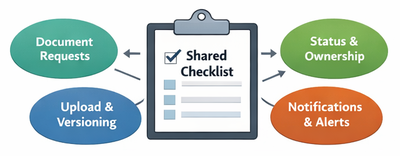
- Reframe documents from “file storage” to “workflow tracking”
Decision: Treat document handling as an end-to-end workflow (requirements → request → receipt → verification → history), not a repository. Why: Email persists because it supports coordination and status tracking—so the product had to do that job better.
- Use a checklist model as the shared source of truth
Decision: Anchor the experience in a checklist/status structure that answers: what’s needed, what’s in progress, what’s done, what changed, who owns it. Why: This reduces ambiguity for both internal teams and external clients, and creates a consistent foundation for later features (notifications, organization, automation).
- Make ownership, visibility, and status explicit (not implied)
Decision: Design for role-based visibility and unambiguous status transitions (with language that users trust). Why: In transaction workflows, unclear “who owns this” creates delays; unclear “status” creates rework and risk.
- Standardize organization defaults before adding “more flexibility”
Decision: Provide sensible default structure (folders/tabs/categories, sorting and filtering patterns, and “pin/priority” behaviors) rather than relying on everyone inventing their own system. Why: Ad-hoc organization scales poorly and increases search time and error rates—especially across teams.
- Invest in version confidence as a first-class requirement
Decision: Prioritize version history and clear draft/final cues (including stacking, timestamps, and traceability). Why: Version confusion is a trust-breaker; users can’t move fast if they fear sharing the wrong thing.
What changed
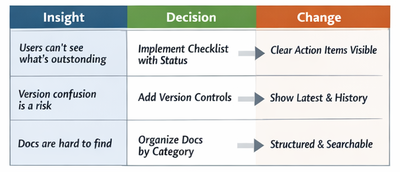
Roadmap & scope changes
- The roadmap shifted from “improve upload” to “support workflow clarity” (tracking, status, ownership, visibility).
- Document organization and versioning were treated as strategic enablers—not nice-to-haves—because they determine whether the system works at scale.
Design & UX changes
- Checklist-based experience became the core navigation layer for document work (what’s outstanding, who owes what, what’s completed).
- Status language and interaction patterns were refined through iterative testing to reduce misinterpretation.
- Organization patterns were elevated: default structures, better sorting/filtering, and pathways to reduce scanning and “where did it go?” confusion.
- Version confidence was explicitly designed (history, recency cues, clearer distinctions between draft/final).
Stakeholder alignment outcomes
- Research artifacts created a shared mental model across product/design/ops/engineering—so decisions could be made faster and with less debate about what users “really do.”
Impact
Industry research suggests that a large share of knowledge work is consumed by communication and information retrieval:
- ~28% of time is spent managing email (reading/writing/responding)
- ~19% of time is spent searching and gathering information
- Making information more available and searchable can reduce information searching time by as much as ~35% in some contexts
A checklist-driven document system directly targets both buckets:
- fewer emails needed to ask “what’s missing / did you get it?”
- less time spent searching across inbox threads and attachments
- fewer wrong-version loops and duplicate handling